Concrete Pontoon Manufacturers in India: Durable Floating Infrastructure Solutions
Introduction
India's growing marine, industrial, and water infrastructure sectors are creating demand for reliable floating platforms. From reservoirs and water intake facilities to marinas, floating walkways, and passenger terminals, concrete pontoons offer a practical solution for projects requiring engineered floating structures.
Choosing the right concrete pontoon manufacturers in India is essential for achieving structural strength, stability, durability, and dependable performance. The right solution depends on the project's purpose, water conditions, load requirements, and installation environment.
Vari Pontoons provides floating infrastructure solutions for a range of water-based applications. Understanding concrete pontoon technology, its benefits, and its applications can help project owners make informed decisions when planning new floating infrastructure.
What Are Concrete Pontoons?
Concrete pontoons are floating structures manufactured using reinforced concrete and an engineered buoyancy system. They are designed to support their own weight and specified operational loads while remaining afloat.
Some concrete pontoon designs incorporate an expanded polystyrene (EPS) core or another suitable buoyancy arrangement. The concrete shell provides structural protection, while the buoyancy system helps the platform displace sufficient water to support the intended load.
Depending on the application, concrete pontoons can be manufactured in different sizes and configurations. Multiple units may also be connected to create larger floating platforms when the connections and overall system are appropriately engineered.
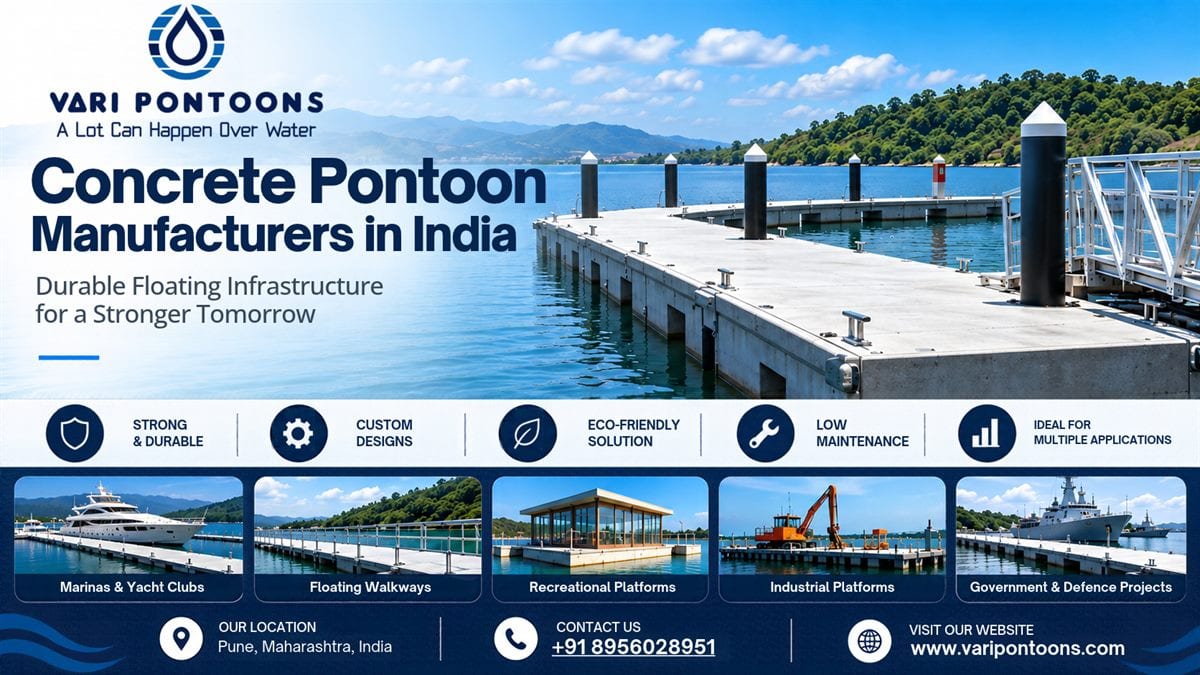
Common applications include floating pump stations, concrete walkways, marine docks, sports decks, passenger terminals, and specialized industrial platforms.
Why Is the Demand for Concrete Pontoon Manufacturers in India Growing?
India has an extensive network of rivers, reservoirs, lakes, canals, and coastal areas. These water bodies create opportunities for floating infrastructure in public utilities, tourism, transportation, and industrial operations.
Concrete pontoons can be considered for projects requiring robust floating structures and stable working surfaces.
1. Water Infrastructure Projects
Water supply and irrigation projects may require floating platforms for pumps, intake equipment, pipelines, and maintenance activities. A properly engineered concrete pontoon can provide a working platform where water levels change during operation.
2. Marine and Waterfront Facilities
Ports, jetties, marinas, and passenger facilities may require floating access platforms. Concrete pontoons can be designed for suitable applications where structural performance, stability, and operational requirements are important.
3. Tourism and Recreation
Waterfront resorts, recreational facilities, and tourism destinations can benefit from floating walkways, decks, and access platforms. The design must consider pedestrian loads, water conditions, accessibility, and appropriate safety arrangements.
4. Industrial Applications
Industrial projects sometimes require floating platforms for equipment installation, inspection, and maintenance. Custom-designed concrete pontoons can be evaluated for these applications according to equipment weight and operating conditions.
Key Benefits of Concrete Floating Pontoons
Selecting a concrete pontoon system offers several potential advantages when the design is matched to the project.
Structural Strength
Reinforced concrete provides a substantial structural shell for suitable floating applications. Appropriate reinforcement, concrete specifications, and construction quality help the structure withstand its intended loads and environmental exposure.
Stability and Load Support
Concrete pontoons can provide stable working surfaces when designed with suitable dimensions, buoyancy, freeboard, and load distribution. Engineering assessments are important to ensure safe performance under expected operating conditions.
Durability
Quality materials, proper construction, and regular inspections can support long-term performance. Concrete durability depends on factors such as water exposure, reinforcement protection, workmanship, and maintenance.
Customised Design Options
Concrete pontoons can be developed in different dimensions and configurations. Depending on the project, designs may accommodate equipment mounts, access arrangements, connection points, and specialized deck layouts.
Versatile Applications
Concrete floating platforms can serve water utilities, marine facilities, industrial operations, and recreational developments. The most suitable material and configuration should be selected according to the project's technical requirements.
How Are Concrete Pontoons Manufactured?
The manufacturing process depends on the design, but several important stages contribute to the quality and reliability of a concrete pontoon.
- Design and engineering: The manufacturer evaluates the intended application, platform dimensions, expected loads, water conditions, buoyancy, and stability requirements.
- Reinforcement and mould preparation: Reinforcement and moulds are prepared according to the approved design. Buoyancy components and embedded fittings are positioned where required.
- Concrete casting and curing: Concrete is placed and cured using appropriate procedures. Workmanship, reinforcement cover, and quality control are essential to the finished structure.
- Quality inspection: The completed pontoon is inspected against project specifications. Depending on the design, checks may include dimensions, concrete quality, structural details, buoyancy, stability, and watertightness.
- Transportation and installation: The pontoon is transported to the site, positioned, connected, and secured according to the installation plan and site conditions.
A well-managed manufacturing process helps ensure that the finished product meets the technical requirements established for its intended application.
Concrete Pontoons Compared with Other Pontoon Materials
Concrete is one of several materials used for floating platforms. Steel, high-density polyethylene (HDPE), and fibre-reinforced plastic (FRP) may also be appropriate depending on the application.
Concrete pontoons can offer a robust structure for suitable heavy-duty uses. Steel systems provide fabrication flexibility but require appropriate corrosion protection. HDPE and FRP systems are generally lighter and may be useful where handling, modularity, or portability is important.
There is no universally best material. Project owners should compare structural requirements, payload, water conditions, installation methods, maintenance needs, and expected service life before making a selection.
How to Choose the Right Concrete Pontoon Manufacturer in India
Selecting a manufacturer requires more than comparing prices. The supplier should understand the project's operating conditions and be able to provide a suitable technical solution.
1. Evaluate Engineering Expertise
Ask about the manufacturer's ability to assess structural loads, buoyancy, freeboard, stability, mooring arrangements, and environmental exposure.
2. Check Material Quality
Review concrete specifications, reinforcement details, manufacturing procedures, and available quality-control documentation. Marine and aggressive water environments may require additional durability considerations.
3. Understand the Buoyancy System
Ask how the pontoon achieves buoyancy and how the design addresses potential damage or water ingress. If an EPS core is used, understand its role and protection within the complete structure.
4. Look for Customisation Capabilities
The manufacturer should assess your required dimensions, platform layout, equipment integration, access arrangements, and connection requirements.
5. Review Installation Support
Transportation, anchoring, mooring, site preparation, and commissioning can affect project performance. Clarify which installation services and technical support are included.
6. Compare Long-Term Costs
Consider the initial price alongside transportation, installation, inspection, maintenance, and expected service life. A technically suitable system may provide better overall value than an option selected on purchase price alone.
Why Consider Vari Pontoons for Floating Infrastructure?
Vari Pontoons offers floating infrastructure solutions for water utilities, marine facilities, recreation, and specialized applications.
Its concrete pontoon range includes solutions for applications such as pump platforms, floating sports decks, concrete walkway docks, floating gym decks, and boat terminals. The suitability of each solution depends on the project's requirements and the final engineering design.
When planning a concrete pontoon project, it is important to discuss the intended use, expected load, water conditions, platform dimensions, mooring requirements, and installation arrangements.
Vari Pontoons can be considered when evaluating floating infrastructure options for your project.
Explore the Vari Pontoons Concrete Pontoons page to learn more about the available solutions.
Applications of Concrete Pontoons Across India
Concrete pontoons can support different types of floating infrastructure when appropriately designed.
- Water utilities: Floating pump platforms and water intake facilities.
- Marine infrastructure: Suitable docks, jetties, and access platforms.
- Tourism and recreation: Floating walkways and recreational decks.
- Industrial operations: Specialized platforms for equipment and maintenance.
- Public infrastructure: Project-specific floating structures for selected waterways and reservoirs.
Every project requires an assessment of structural loads, buoyancy, stability, environmental conditions, anchoring, and applicable safety requirements.
Conclusion
Concrete pontoons offer a practical option for floating infrastructure projects that require a robust structure and carefully engineered buoyancy. Their suitability depends on the application, environmental conditions, load requirements, and installation design.
When comparing concrete pontoon manufacturers in India, consider engineering expertise, material quality, customisation, quality assurance, and installation support rather than focusing only on the initial cost.
Vari Pontoons provides concrete floating solutions for various water-based applications. If you are planning a floating walkway, pump platform, sports deck, or marine facility, explore the available options and discuss your technical requirements with the team.
Planning a concrete pontoon project?
Visit Vari Pontoons to discuss your floating infrastructure requirements.