
Mounted Drilling Rig
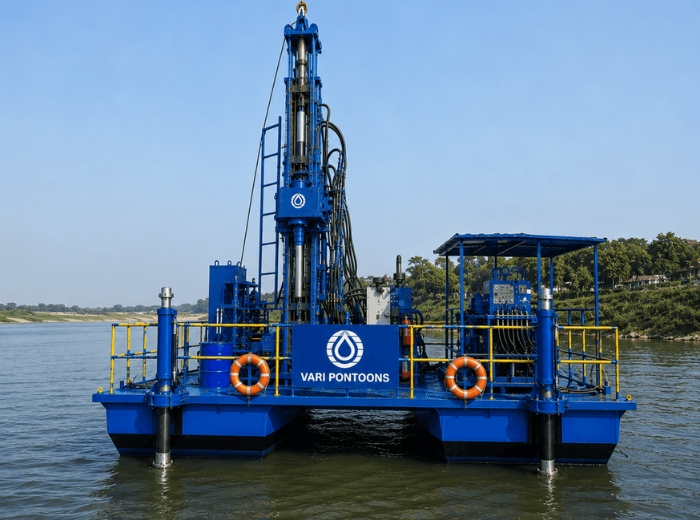
The Pontoon Mounted Drilling Rig is a purpose-built floating platform designed to support geotechnical drilling rigs for borehole investigation and subsurface exploration across rivers, lakes, reservoirs and other aquatic environments. Built as a welded steel barge, the platform is engineered to carry the full weight of the drilling rig, rods, crew and equipment while maintaining the stability, safety and structural integrity required for accurate, hazard-free drilling operations over water.
- Welded steel barge platform engineered for a 35–40 MT design load
- Heavy-duty steel grillage and load distribution beams beneath the rig base
- Four-spud position holding system for precise, drift-free drilling
- Wide-beam, compartmentalized hull for maximum lateral stability
Where the Pontoon Mounted Drilling Rig Is Deployed
Engineered for geotechnical investigation and borehole drilling across a wide range of aquatic environments — from rivers and lakes to reservoirs and coastal waters

Borehole Drilling & Subsurface Investigation
Geotechnical borehole drilling and subsurface investigation carried out safely over open water bodies.

Riverbed & Lakebed Surveys
Stable drilling platforms for riverbed and lakebed geotechnical surveys and soil investigation programs.

Reservoir & Dam Investigation
Reservoir and dam-site ground investigation projects requiring reliable, anchored floating platforms.

Coastal & Wetland Ground Exploration
Ground exploration and infrastructure planning surveys across coastal zones and wetland sites.
Structural & Stability Enhancements
Every Vari Pontoons drilling platform is engineered with the structural and functional enhancements needed for safe, efficient rig mounting. Heavy-duty grillage, rigid anchoring, a wide-beam hull and a compartmentalized structure work together to deliver a stable, hazard-free working surface for geotechnical drilling operations over water.

Steel grillage and load distribution beams beneath the drilling rig ensure even transfer of load across the deck.

Rigid bolting and anchoring arrangements secure the rig firmly to the deck during active operations.

A wide beam pontoon configuration maximises lateral stability and resists overturning moments.

Compartmentalized construction maintains buoyancy control and contains damage, protecting crew and equipment.
Loads to Be Considered
The following loads are accounted for in the structural and stability design of every pontoon-mounted drilling platform
Recommended Pontoon Specifications
| Parameter | Description |
|---|---|
| Pontoon Type & Dimensions | 12 m × 8 m × 1.8 m welded steel barge |
| Working Deck Area | Approx. 96 m² usable platform surface |
| Deck Plate & Structure | 8 mm plate with transverse and longitudinal stiffeners |
| Payload Capacity | Minimum 35–40 MT design load (rig, rods, crew, mud/water & safety margin) |
| Estimated Rig Weight | 20–30 MT operating rig weight |
| Position Holding | Four-spud arrangement — two front and two rear hydraulic spuds |
| Stability Features | Wide-beam hull, compartmentalized construction, ballast system |
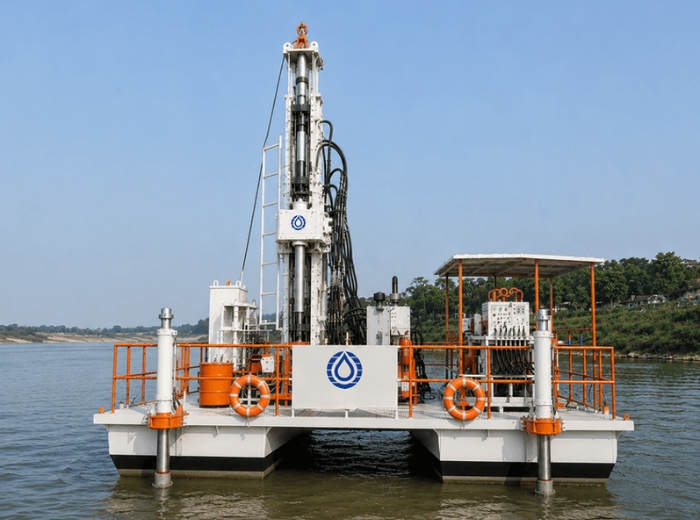
Four-Spud Hydraulic Anchoring
Maintaining platform position during drilling operations is critical for accuracy and safety. Two rear and two front hydraulic spuds are deployed to anchor the pontoon firmly in position, providing balanced, four-point restraint. The spuds penetrate the riverbed or lakebed to prevent lateral drift caused by water currents, wind loads and wave action throughout the drilling cycle — enhancing borehole positioning accuracy and ensuring crew safety by eliminating uncontrolled platform movement.
- Four hydraulic spud legs for superior stability and precise positioning
- Prevents drift, roll and pitch for safe, accurate drilling
- Fast hydraulic deployment across rivers, lakes and reservoirs