

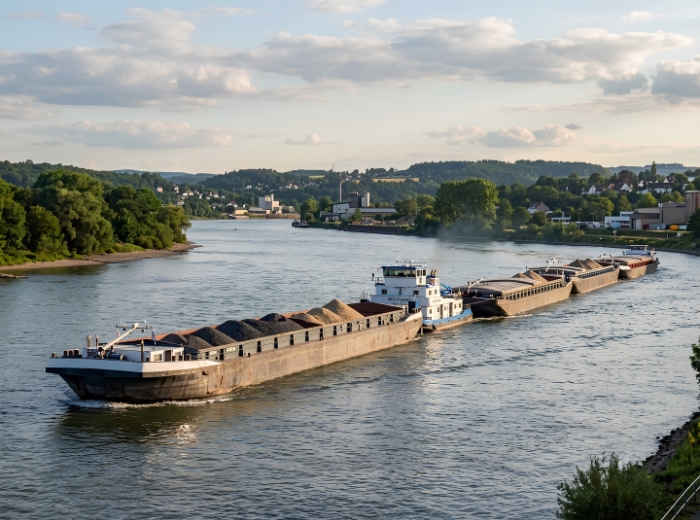
High-Capacity Platforms for Bulk & Containerized Freight
Our cargo barges are engineered to move bulk materials, palletized goods, and containerized freight across rivers, canals, and coastal waters. Reinforced steel pontoon hulls provide a stable, high-load deck suited to loading and unloading with cranes, conveyors, or forklifts.
Deck configurations range from open flat-top layouts for construction materials to raised coamings for aggregate and bulk cargo, with optional bulkheads for compartmentalized loads. Shallow draft designs allow access to waterways with limited depth.
- Flat-Deck & Coamed-Hopper Configurations Available
- Shallow Draft for Inland & Near-Shore Access
- Compatible with Tug & Push-Boat Operations
- Reinforced Deck for Crane & Forklift Loading
Typical Applications
Cargo Barges are configured to suit a wide range of freight movement requirements, including:

Bulk Material Transport
Sand, aggregate, coal, and other loose bulk cargo movement across rivers, canals, and coastal waters.

Container Handling
Deck layouts sized for standard container footprints and lashing points.

Construction Material Logistics
Movement of steel, precast elements, and heavy building materials to site.

Inland Waterway Freight
Scheduled freight movement along rivers and canal networks.
Built for Consistent, Heavy-Cargo Operation
Every feature is selected to keep cargo moving reliably across demanding waterway and loading conditions.

Structural design rated for consistent heavy-cargo operation across rivers, ports, and coastal waters.

Flat-top, coamed, or bulkheaded layouts configured to suit the cargo type being carried.

Coatings and materials suited to fresh, brackish, or marine water operating environments.

Access to waterways with limited depth without compromising on-deck stability.
Cargo Barges — Typical Specifications
| Parameter | Indicative Specification |
|---|---|
| Hull Material | Marine-grade steel with corrosion-protective coating |
| Deck Configuration | Flat-top, coamed hopper, or bulkheaded — configurable |
| Load Capacity | Low to high, sized to project cargo requirements |
| Draft | Shallow, suited to inland and near-shore operation |
| Propulsion | Self-propelled or tug/push-boat compatible |
| Certification & Compliance | Aligned with applicable inland/marine class standards |
Planning a Cargo Movement Project?
Speak with our team about a cargo barge configuration for your route and load requirements.
Other Barges in This Range